Ride & Drive — Automotive Marketplace
Context
Ride & Drive is an automotive marketplace connecting buyers, car dealers, and internal sales teams.
When I joined the project, the company was forced to migrate to a new vehicle management system after the previous provider announced bankruptcy.
The new operational system was Dealer Center, which became the single source of truth for vehicle inventory, attributes, and dealership workflows. At the same time, the external team responsible for maintaining the website also shut down, creating a critical need to rebuild the platform while ensuring full alignment with the new system and long-term independence.
My Role
Product Designer
I was responsible for end-to-end product design, working closely with business stakeholders and the development team. My focus was on aligning the website with the new operational system, removing dependency on external vendors, and improving internal efficiency through product-level solutions.
Key Product Challenges
• Migration to a new vehicle management system with different data structures and constraints
• Strong dependency on external teams for even basic website updates
• Manual, paper-based credit application process creating operational overhead
• Risk of inconsistencies between internal systems and the public-facing website
Case 1 — Regaining Platform Control and System Consistency
Problem
After switching to a new vehicle management system, the business needed the website to accurately reflect how vehicles, attributes, and data were structured internally.
Previously, any mismatch between the operational system and the website created confusion for internal teams and limited the company’s ability to scale or adapt quickly.
At the same time, the business wanted to eliminate its dependency on external development teams for routine website changes.
Discovery
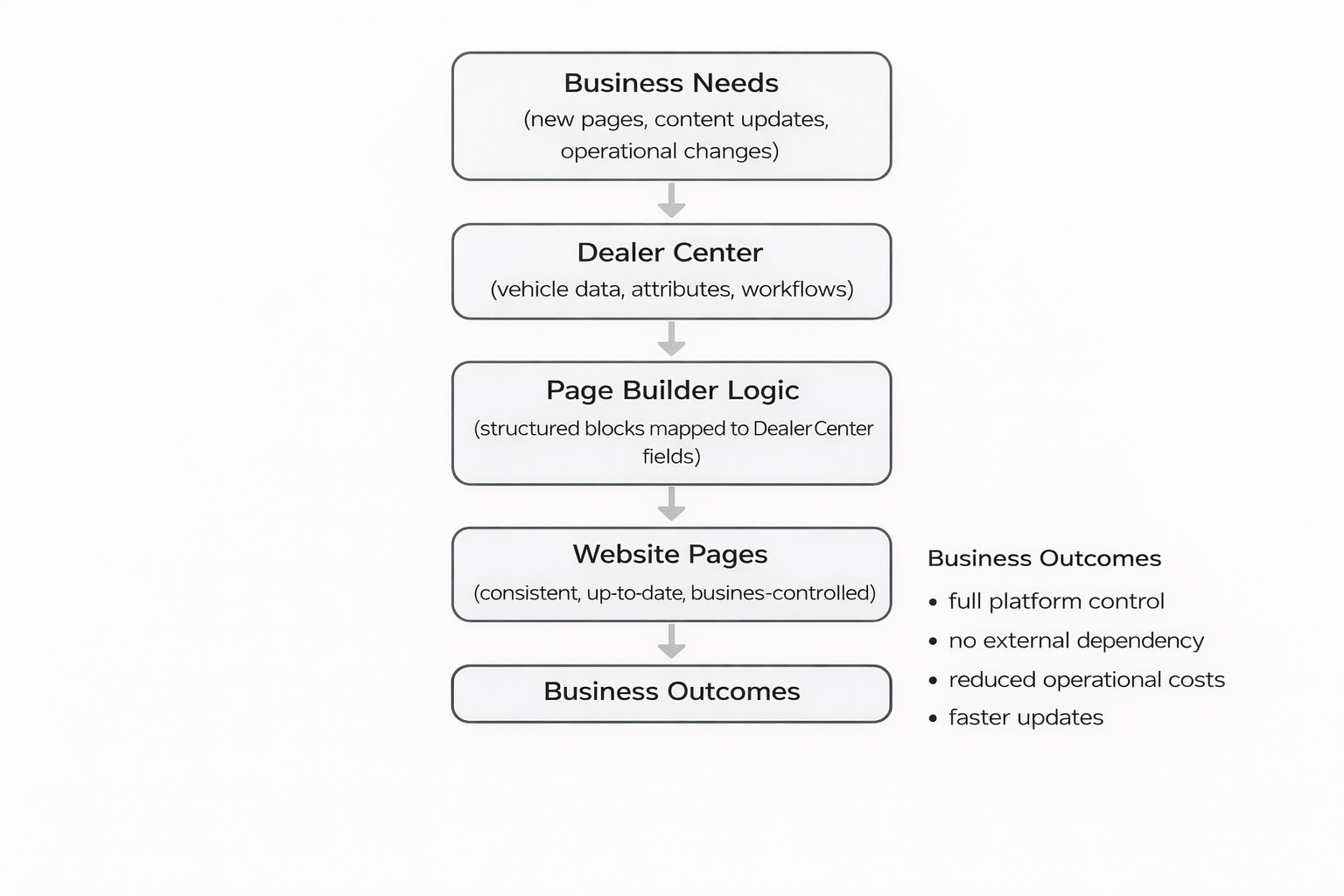
I started by studying the Dealer Center documentation to understand its data model, available fields, and operational constraints. This allowed me to design website structures and page components that accurately reflected how vehicles and attributes were managed internally.
Insight & Hypothesis
The key insight was that customers were already willing to provide this information themselves — the system simply did not support a secure and structured digital flow.
Hypothesis:
If customers could submit credit applications digitally through a secure, well-structured form aligned with business requirements, the process would become faster, safer, and significantly less resource-intensive.
Solution
I designed a page builder system composed of reusable, structured blocks that directly mapped to the fields and entities of the new vehicle management system.
To ensure feasibility and long-term stability, I:
• aligned block structures with system documentation,
• validated technical constraints with the development team,
• and reviewed proposed structures with business stakeholders to confirm real operational needs.
The resulting page builder allowed internal teams to:
• create new pages independently,
• modify existing content without developer involvement,
• and maintain full consistency between internal systems and the website.
Result
After launch:
• the business regained full control over the website,
• dependency on outsourced development teams was eliminated,
• operational costs related to website maintenance were reduced from $2,500–$6,000 per month to zero,
• and internal teams gained the ability to react quickly to business needs without technical bottlenecks.
Case 2 — Eliminating Manual Credit Application Workflows
Problem
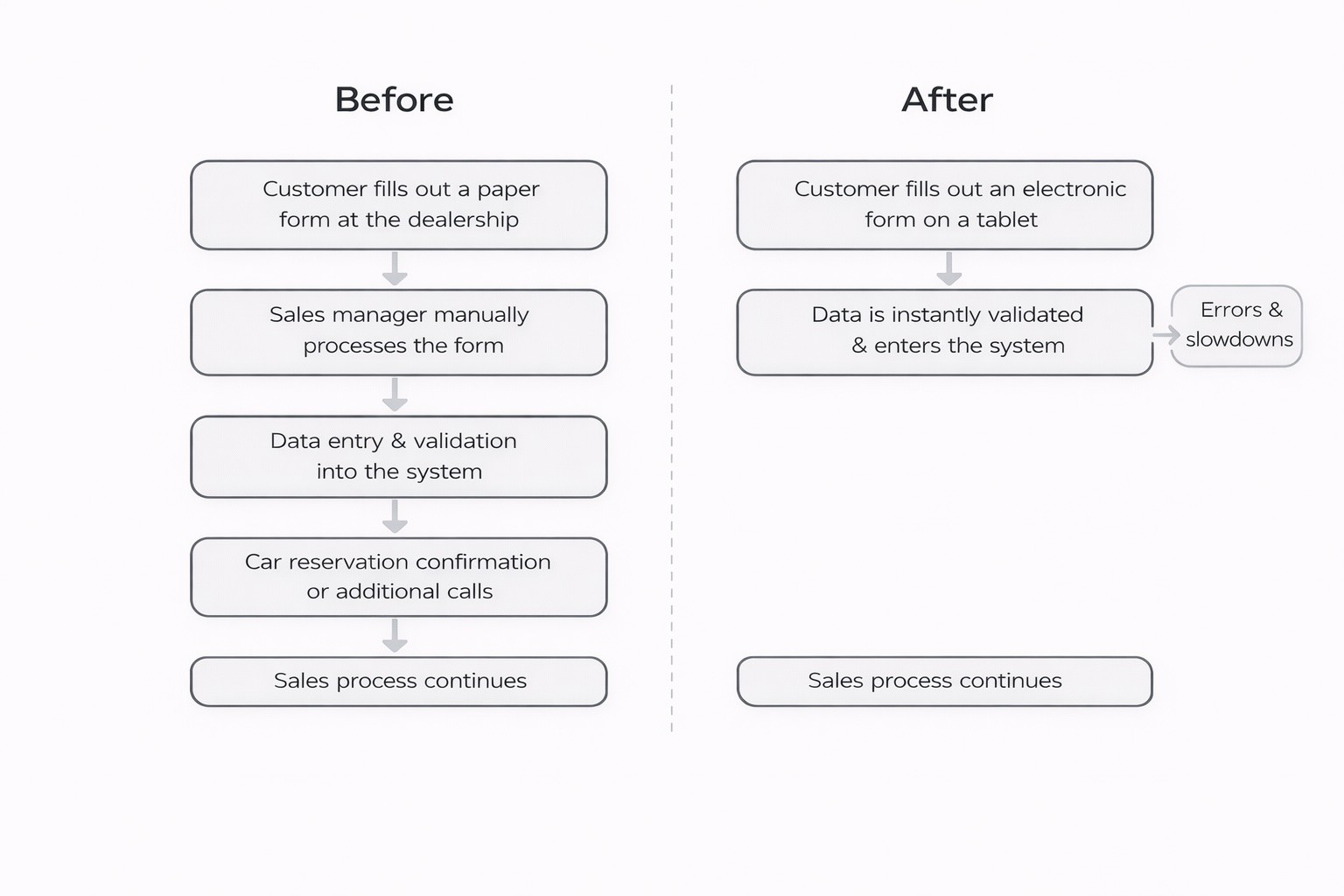
Vehicle financing applications were handled using paper forms, which were later manually transferred into creditor systems by sales managers.
This process:
• slowed down application processing,
• increased the risk of errors,
• and placed unnecessary workload on internal teams.
Discovery (Data & Heuristic Analysis)
I studied the documentation of the new operational system and reviewed the requirements for submitting credit applications, including security and compliance constraints.
The process involved sensitive personal data such as Social Security Numbers and other private user information, which required careful handling and secure data transmission.
I also worked closely with business stakeholders to understand which data points were critical and how applications were processed internally.
Insight & Hypothesis
The key insight was that customers were already willing to provide this information themselves — the system simply did not support a secure and structured digital flow.
Hypothesis:
If customers could submit credit applications digitally through a secure, well-structured form aligned with business requirements, the process would become faster, safer, and significantly less resource-intensive.
Solution
I designed a secure online credit application flow based on multiple iterations.
Each iteration was:
• aligned with system documentation and security requirements,
• reviewed with business stakeholders,
• and validated with the development team to ensure technical feasibility and compliance.
The final solution allowed customers to submit all required information directly, while ensuring data integrity and security.
Result
After implementation:
• paper-based workflows were fully eliminated,
• sales managers were freed from repetitive manual data entry,
• application processing became faster and more reliable,
• and the overall sales workflow became significantly more efficient.
Key Takeaway
Designing products that align internal systems, business processes, and user experience can dramatically reduce operational costs, increase control, and unlock long-term scalability.
© 2026 Mark Berladyn. All rights reserved.